

Unraveling the Mystery of BEV, REEV, HEV, PHEV, and FCEV
The names can be confusing. The real question is: which one makes sense for the way you actually drive?
This guide breaks down; what each system does, what it means for your daily driving, and where each one makes the most sense.
What are Battery Electric Vehicles (BEVs)?
A Battery Electric Vehicle (BEV) runs entirely on electricity. A large battery powers an electric motor, with no gasoline engine and no tailpipe emissions.
Why this matters for your decision: a BEV means your driving depends on access to charging rather than gasoline.
Why Some Drivers Choose a BEV
Quiet, smooth driving with no gasoline engine.
Lower routine maintenance because there are fewer conventional engine components.
No gasoline stops if you can charge where you live or work.
What You Need to Consider
Charging access: Can you charge at home, work, or somewhere convenient?
Driving range: Will the vehicle comfortably cover your normal driving and occasional longer trips?
Charging time: A BEV requires more planning than simply stopping for five minutes at a gas station.
Upfront cost: The purchase price can be higher than a comparable gas vehicle.
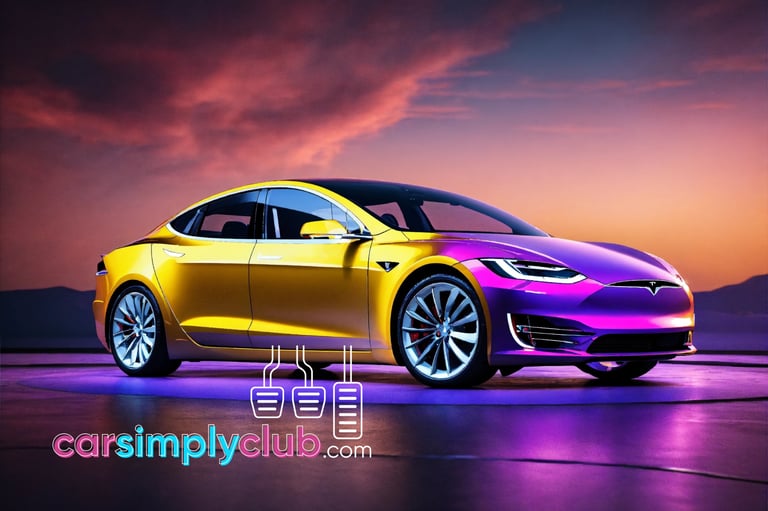
Examples: Tesla Model S, Nissan Leaf, Chevrolet Bolt EV and many others.

Plug-in vs. fill-up: what each EV type runs on and how to refuel it Want the deeper tech breakdown? Scroll down ↓
What Is a Range-Extended Electric Vehicle (REEV)?
A Range-Extended Electric Vehicle (REEV) uses an electric motor to drive the vehicle, while a gasoline engine acts as a generator to produce electricity when the battery needs additional energy.
The key difference: the gasoline engine does not directly drive the wheels.
Why a REEV Might Make Sense
A REEV can be appealing if you want to drive electrically most of the time but don't want your longer trips to depend entirely on charging infrastructure.
Electric driving for everyday trips when the battery has enough charge.
A gasoline backup for longer journeys when charging isn't convenient.
Less dependence on public charging for drivers who regularly travel long distances.
The question isn't whether a REEV is "better" than a BEV. It's whether the extra flexibility is worth it for the way you drive.
What You Give Up
The flexibility of a REEV comes with trade-offs:
More mechanical complexity than a BEV because the vehicle has both an electric drivetrain and a gasoline engine.
Engine maintenance still exists, including maintenance associated with the gasoline system.
Electric-only range may be shorter than a comparable BEV.
Potentially higher purchase cost because you're carrying two systems.
A REEV makes the most sense when its flexibility solves a real problem for you. If you rarely take long trips, you may be paying for a backup system you don't use very often.
Notable models include: BMW i3 REx and Chevrolet Volt.


What Is a Plug-in Hybrid Electric Vehicle (PHEV)?
A Plug-in Hybrid Electric Vehicle (PHEV) combines an electric motor and gasoline engine, but unlike a conventional hybrid, its battery can be charged by plugging the vehicle into an external power source.
A PHEV can drive on electricity for a limited distance before using its gasoline system when additional range is needed.
Why a PHEV Might Make Sense
A PHEV can work particularly well for drivers whose daily trips are short enough to fit within the vehicle's electric range, but who still regularly need gasoline-powered range for longer journeys.
Electric driving for shorter trips when the battery is charged.
Gasoline range when you need to travel farther.
Home charging can cover many daily trips without requiring frequent public charging.
No need to plan every long trip around charging stations.
If your normal commute fits within the electric range and you can charge regularly, a PHEV can let you use very little gasoline for everyday driving.
What You Give Up
A PHEV's flexibility comes with a few trade-offs:
Shorter electric range than a typical BEV.
More mechanical complexity because the vehicle carries both electric and gasoline systems.
Potentially higher purchase cost than a comparable conventional hybrid or gas vehicle.
You need to charge it regularly to get the full benefit of its electric capability.
A PHEV only delivers its full advantage when you actually plug it in. If you rarely charge, you're carrying around a larger battery without getting as much value from it.
Examples include: Mitsubishi Outlander PHEV, Toyota RAV4 Plug-in Hybrid and Ford Escape PHEV.
When EV Types Overlap: Clearing Up the Confusion
Both PHEVs and REEVs combine gasoline and electric technology, so it's easy to assume they're basically the same thing.
They're not.
The key question is simple:
Does the gasoline engine actually drive the wheels?
How a PHEV Works
In a PHEV, both the electric system and gasoline engine can contribute to moving the vehicle.
The gasoline engine can mechanically drive the wheels, while the electric motor can also provide propulsion.
Think of it as two propulsion systems working together.
How a REEV Is Different
In a REEV, the wheels are driven by the electric motor.
The gasoline engine does not mechanically drive the wheels. Instead, it acts as an onboard generator that produces electricity for the vehicle's electric system.
Think of it as an electric vehicle with a gasoline-powered backup generator.
The Difference That Matters
PHEV: The gasoline engine can drive the wheels.
REEV: The gasoline engine generates electricity, but does not drive the wheels.
If you're trying to tell these two apart, don't ask whether they have a battery and a gas engine. Both do. Ask one question: Does the gas engine drive the wheels?



What Is a Hybrid Electric Vehicle (HEV)?
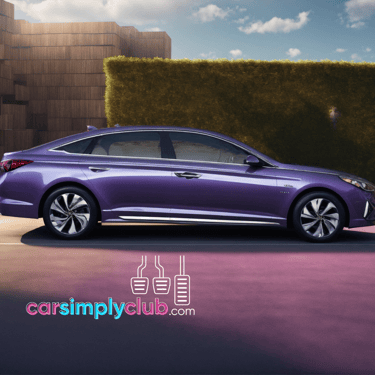
A Hybrid Electric Vehicle (HEV) combines a gasoline engine with an electric motor and battery.
Unlike a PHEV, a standard HEV does not need to be plugged in. The battery is recharged automatically through regenerative braking and, when needed, the gasoline engine.
The electric system helps reduce how much gasoline the vehicle uses, particularly during low-speed driving and acceleration.
Why an HEV Might Make Sense
An HEV can be a good fit for drivers who want better fuel efficiency without changing how they use their vehicle.
No charging required. Fill it up at a regular gas station.
Better fuel economy than many comparable gasoline vehicles.
Regenerative braking helps recharge the battery while you drive.
Electric assistance can reduce fuel consumption in stop-and-go driving.
No need to plan your trips around charging stations.
If you want some of the efficiency benefits of electrification but don't want to plug in, an HEV may be the simplest transition.
What You Give Up
An HEV isn't a small BEV.
Its battery is generally much smaller, so electric driving is limited and the gasoline engine remains the primary source of propulsion for many driving situations.
You also don't get the same potential fuel savings as a PHEV or BEV when those vehicles are regularly charged and driven electrically.
And because an HEV still has a gasoline engine, you still have engine-related maintenance and fuel costs.
The biggest advantage of an HEV is also its biggest limitation: you don't have to change your routine. You simply keep driving and filling up with gas.
Real-World HEVs
Examples include the Toyota Prius, Honda Insight and Ford Fusion Hybrid.
These vehicles helped make hybrid technology mainstream and show how much fuel efficiency can improve without requiring drivers to switch to plug-in charging.

No fluff — straight into the tech behind how each system actually works. Missed the basics? Scroll back up ↑
What Is a Fuel Cell Electric Vehicle (FCEV)?
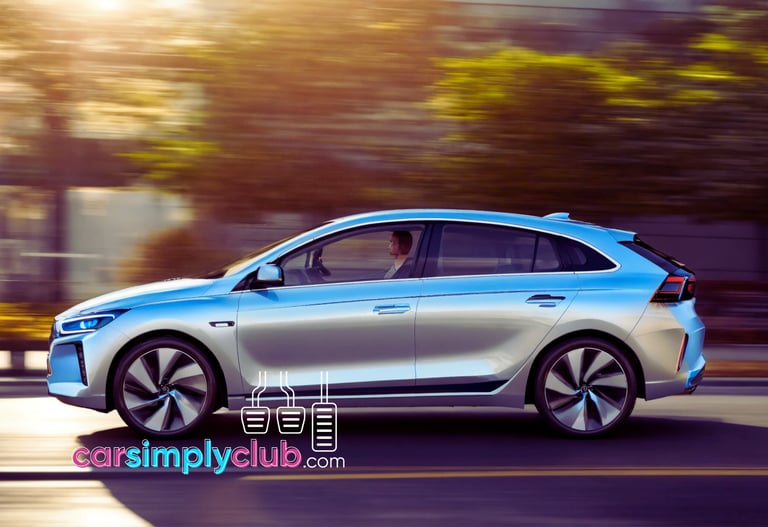
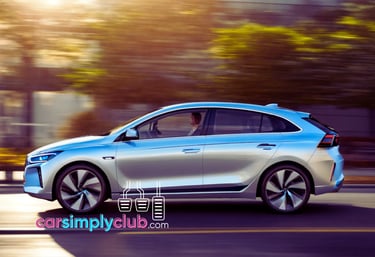
A Fuel Cell Electric Vehicle (FCEV) is an electric vehicle that uses hydrogen to produce electricity onboard.
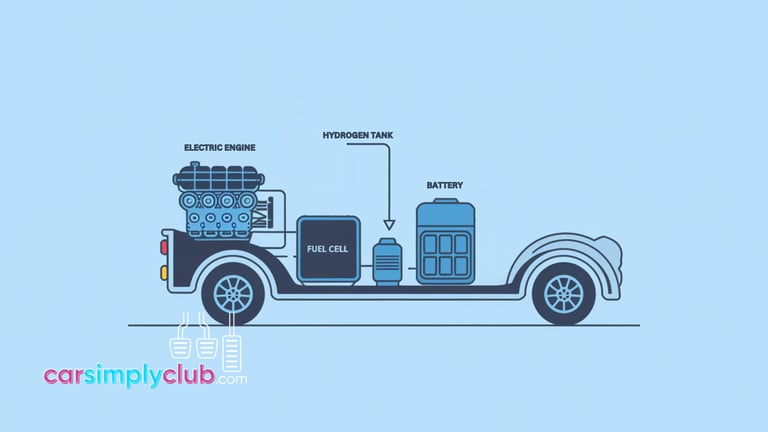
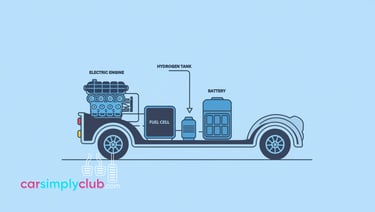
Instead of storing all its energy in a large battery, an FCEV carries hydrogen in a fuel tank. A fuel cell uses that hydrogen to generate electricity, which powers the electric motor.
Like a BEV, an FCEV has no gasoline engine and produces no tailpipe emissions.
Why an FCEV Might Make Sense
The biggest appeal of an FCEV is that it combines electric driving with fast refueling.
Electric motor propulsion for a quiet, smooth drive.
No gasoline required.
Hydrogen refueling can be completed in minutes, rather than requiring a lengthy charging session.
No tailpipe emissions from the vehicle itself.
Long driving range can be possible without carrying an extremely large battery.
If you want electric driving but don't want to wait for a battery to charge, hydrogen offers a very different approach.
What You Give Up
The technology comes with one major practical question:
Where will you refuel?
Hydrogen refueling infrastructure is much less widespread than gasoline stations or EV charging stations. That can make an FCEV difficult to use depending on where you live and where you regularly drive.
Other considerations include:
Limited hydrogen availability compared with gasoline and public EV charging.
Higher vehicle costs can make FCEVs less accessible.
Hydrogen production and distribution can affect the overall environmental benefits.
Your location matters enormously because an FCEV is only practical if you have reliable access to hydrogen.
An FCEV can solve the charging problem, but it doesn't eliminate the infrastructure problem. Before considering one, find out whether hydrogen is actually available where you drive.
Real-World FCEVs
Examples include the Toyota Mirai and Hyundai Nexo.
FCEVs show that electric propulsion doesn't necessarily have to mean plugging into a charger. But unlike a BEV or PHEV, your decision depends heavily on access to hydrogen refueling.
Is an EV Always the Greener Choice?
EVs can reduce tailpipe emissions and, depending on how electricity is produced, can have lower overall emissions than gasoline vehicles. But the environmental picture doesn't begin when you leave the dealership.
Battery manufacturing requires significant amounts of energy and raw materials, and different battery chemistries have different material requirements.
For example, LFP (lithium iron phosphate) batteries don't use nickel or cobalt, while other battery chemistries do.
That doesn't mean one battery chemistry is automatically "good" and another is "bad." It means that there are trade-offs behind the technology you're buying.
The better question isn't "Is an EV green?" It's "Which vehicle and battery technology makes sense for how I actually drive?"
If you want to understand the battery side before making that decision, our EV Battery Guide goes deeper into battery chemistry, lifespan and what the differences can mean for you.
And What About the Cost?
Environmental benefits are only one part of choosing a vehicle.
Your purchase price, financing, fuel or electricity costs, maintenance and how much you actually drive all affect whether a vehicle makes financial sense for you.
If you're comparing your options, you can run the numbers with our free Car Loan Payment Calculator or Car Lease Payment Calculator.
The Right EV Is the One That Fits Your Life
A BEV may make sense for someone who can charge at home and rarely drives long distances.
A PHEV may make more sense for someone who wants electric driving during the week but regularly takes longer trips.
An HEV may be the better fit for someone who wants improved fuel economy without changing how they refuel.
And an FCEV could make sense for a very different driver with reliable access to hydrogen.
There isn't one "best" electrified vehicle. There's the one that fits your driving, your access to infrastructure and your budget.
Leave a Reply
Your email address will not be published. Required fields are marked *
Join The Club!
Stay informed with Car News and Car Tech updates, and exclusive emails right in your inbox.